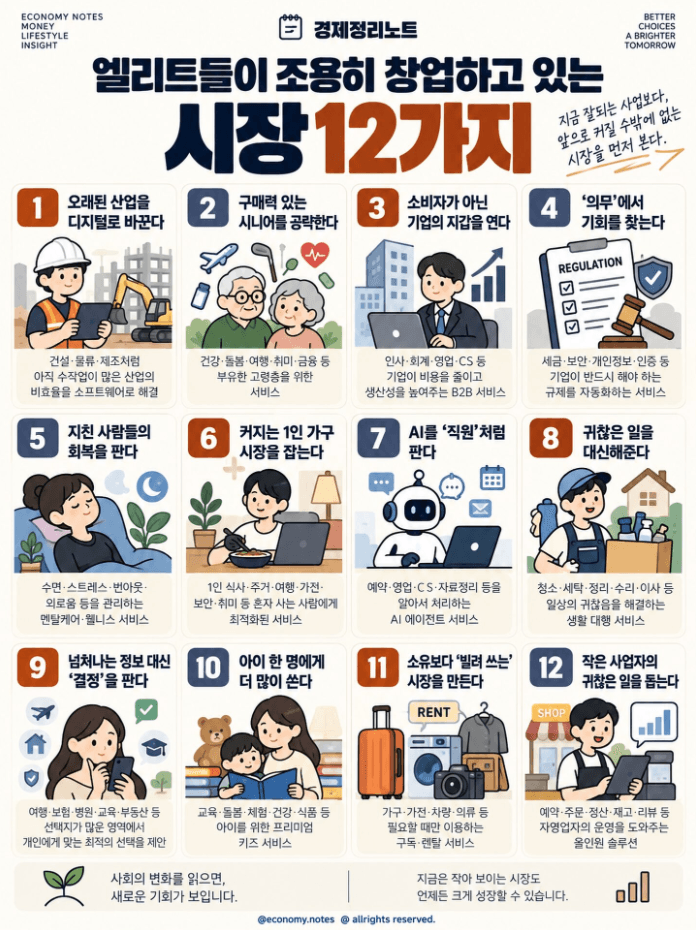
[Repost] 12 markets elite founders are quietly starting companies in
Translated by AIView original
1. Digitizing old industries
Software and AI are fixing the inefficiencies in industries that still run on a lot of manual work, like construction, logistics and manufacturing.
→ The older the industry, the more inefficiencies there are to fix.
2. Targeting seniors with spending power
Beyond health and care, consumer markets for seniors are growing into travel, hobbies, finance and housing.
→ Aging creates a huge shift in consumer spending.
3. Winning over companies, not consumers
B2B services that cut costs and boost productivity for businesses in HR, accounting, sales and customer service.
→ Companies spend on services that make them money or save them money.
4. Finding opportunity in "obligations"
Automating work that companies must do, like taxes, security, personal data and certification.
→ You can build a market where the problem must be solved, which is stronger than optional spending.
5. Selling recovery to tired people
A mental care and wellness market that manages sleep, stress, burnout and loneliness.
→ New life problems create new spending.
6. Catching the growing single-person household market
Services optimized for people who live alone, covering solo meals, housing, travel, appliances, security and hobbies.
→ Family-unit spending is splitting up into individual-unit spending.
7. Selling AI as a "staff member"
AI agent services that handle things like bookings, sales, customer service and organizing materials on their own.
→ AI is moving from a tool that answers questions to one that actually does the work.
8. Doing the annoying chores for people
They take over things that eat up time and effort in daily life, like cleaning, laundry, tidying, repairs and moving.
→ People pay for services that save them their time.
9. Selling "decisions" instead of the flood of information
In areas with too many options, like travel, insurance, hospitals, education and real estate, they suggest the choice that fits each person.
→ The more common information becomes, the more valuable it is to decide what to choose.
10. Spending more on one kid
A premium kids market covering education, care, experiences, health and food.
→ Apart from falling birth rates, it targets spending concentrated on a single child.
11. Building a market for renting instead of owning
Subscription and rental services for furniture, appliances, cars and clothing, used only when you need them.
→ They reduce the burden of ownership and sell the value of the moment you need something.
Comments 0
No comments yet
Be the first to comment.